
Is Your Company At Risk? Data Security & End-of-Life Hardware
Most businesses spend a lot of time thinking about their cybersecurity. They regularly update their firewalls, enforce password policies, and employ teams who are trained to spot phishing emails.
There’s a clear focus on protecting systems that are active and in use, rather than those that are sitting idle.
But there’s one area that often gets overlooked. “What happens to your data when your hardware reaches the end of its life?”
Old laptops, servers, hard drives, and storage devices don’t just stop being a risk when they’re retired and no longer being used. In many cases, they become even more vulnerable because they’re no longer monitored or secured. Alarmingly, if they’re not handled properly, they can quietly expose your business to serious consequences.
That’s where many companies unknowingly put themselves at risk. End-of-life hardware isn’t just an IT issue, but a data security issue, a compliance issue, and a business risk that deserves the same level of attention as your active systems.
Overlooked Risk Sitting in Storage Rooms
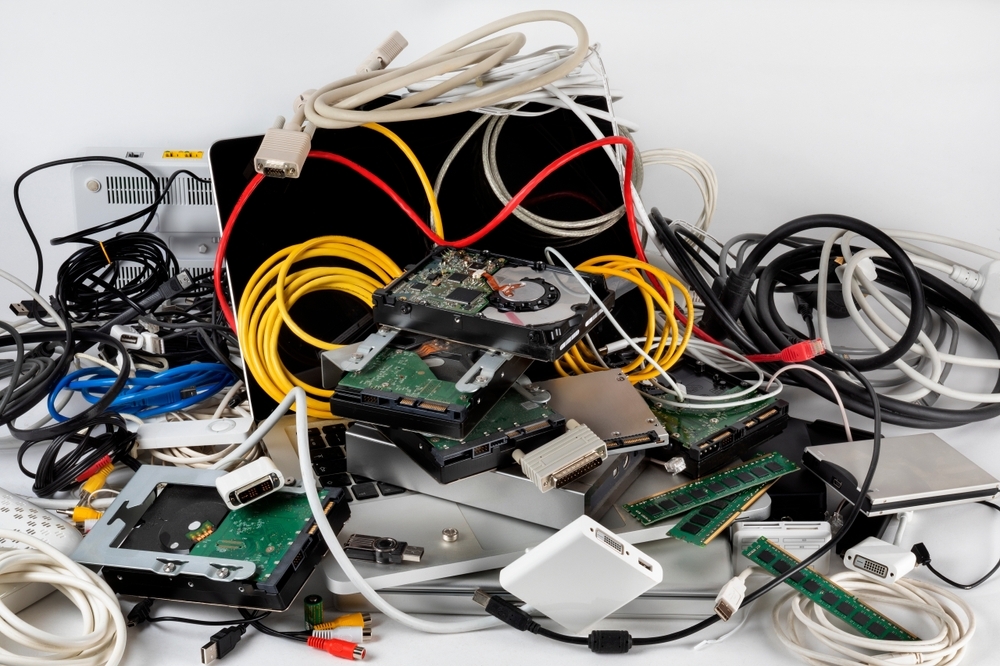
Take a walk through most offices or IT departments and you’ll probably find it because most businesses have the hidden nook or forgotten room. It could be a closet, storage room, or corner filled with outdated equipment, such as old desktops, retired servers, stacks of hard drives. Devices that were once critical to operations but are now just sitting there, waiting for someone to decide what to do with them. Sure, it all might not seem like a big deal at first. However, the devices often still contain sensitive data.
Things like customer records, financial information, employee files, login credentials, or proprietary business data may remain on the device. Even if the systems were wiped or reset, that doesn’t necessarily mean the data is gone. In many cases, it can still be recovered, which is why it’s a problem. The longer those devices sit unaccounted for, the greater the risk becomes.
This is where many data breaches begin. Many are surprised to learn that breaches are not always the result of sophisticated cyberattacks, but of overlooked physical assets that were never properly handled.
Understanding the Compliance Landscape
For many organizations, data security isn’t just a best practice issue, but a legal requirement Several major regulations directly impact how businesses must handle data, including what happens when hardware is retired.
HIPAA (Health Insurance Portability and Accountability Act)
If your organization handles protected health information, HIPAA requires strict safeguards to ensure that data is properly secured and disposed of. This includes electronic protected health information (ePHI) stored on all devices in the office.
Failing to properly destroy that data when hardware is retired can result in serious penalties from HIPPA. And those penalties aren’t minor. In fact, HIPAA violations can lead to fines that range from thousands to millions of dollars depending on the severity and level of negligence and the breach.
SOX (Sarbanes-Oxley Act)
SOX focuses on financial transparency and the protection of financial records. While it’s often associated with accounting practices, it also applies to how financial data is stored and managed at a business.
Improper disposal of hardware containing financial data can raise compliance concerns and expose companies to audits and penalties which can all cost money and damage your reputation.
GLBA (Gramm-Leach-Bliley Act)
For financial institutions, GLBA requires the protection of sensitive customer information. This includes ensuring that data is securely disposed of when it’s no longer needed. If devices containing customer financial data are not properly handled, it can be considered a violation of GLBA requirements, which is serious.
PCI DSS (Payment Card Industry Data Security Standard)
Any business that processes payment card information must follow PCI DSS guidelines. These standards include strict rules around how cardholder data is stored, accessed, and ultimately destroyed. Always remember that improper disposal of devices that contain payment data can lead to non-compliance, fines, and even the loss of the ability to process payments.
Why End-of-Life Hardware Is a Prime Target
When devices are active, they’re usually protected because they're behind firewalls and are monitored by IT teams. They’re part of a system that’s designed to detect and prevent threats. But once those same devices are retired, that protection often disappears and they become easy targets.
A discarded hard drive or improperly recycled laptop doesn’t have security software running. This means that it doesn’t have monitoring in place. It’s simply a piece of hardware that may still contain valuable data. For someone looking to exploit that data, it’s an opportunity that is all too easy.
This is why improper IT asset disposal continues to be a leading cause of data exposure. It’s not always about hacking into systems. Sometimes, it’s as simple as recovering data from a device that wasn’t properly destroyed.
Data Breach Statistics That Should Get Your Attention
If this still feels like a low-probability risk, the numbers tell a different story. Data breaches are not rare events. In fact, they’re becoming more common, more costly, and more damaging to businesses of all sizes.
The average cost of a data breach has reached into the millions of dollars, with expenses tied to investigation, remediation, legal fees, and lost business. Beyond the financial impact, there’s also the reputational damage that can take years to recover from and even destroy a brand so that they are forced to close their doors.
What’s often overlooked is how many of these breaches are preventable. There are a significant portion of data exposure incidents that are tied to poor data handling practices, including improper disposal of hardware. That means these aren’t unavoidable events because, in reality, they’re the result of gaps in process and oversight. Those gaps are exactly what a strong IT asset disposition strategy is designed to close.
The Role of Chain of Custody in Data Security
One of the most important concepts in secure IT disposal is chain of custody. This term refers to the ability to track your hardware from the moment it leaves your control all the way through its final disposition (this is chain of custody). It ensures that every step of the process is documented, verified, and accountable so you know what’s happening, where it’s happening, and when it’s happening. Without chain of custody, there’s uncertainty.
You don’t know exactly where your equipment is when you don’t have a chain of custody. You don’t know who has handled it and you don’t have proof of what was done with it. That’s a big problem. Because if something goes wrong, your business is still responsible for everything.
A strong chain-of-custody process includes detailed tracking, secure transportation, and clear documentation at every stage. It provides visibility into the entire lifecycle of your assets, even after they’ve left your facility so you know everything. Without a doubt, this level of transparency is critical for both security and compliance.
Why Documentation Matters
When it comes to IT disposal, documentation isn’t just paperwork, but proof. Two of the most important documents in this process are Certificates of Destruction and detailed asset reports.
A Certificate of Destruction confirms that data on a device has been securely and permanently destroyed. It serves as official verification that your organization has met its data disposal obligations completely.
Asset disposition reports, on the other hand, provide a detailed record of what equipment was processed, including serial numbers, and acknowledge a transfer of ownership.
Together, these documents create a very clear, auditable trail. If your company is ever audited or needs to demonstrate compliance, this documentation becomes essential. Without it, there’s no way to prove that your data was handled properly. In many cases, that lack of proof can be just as problematic as a data breach itself.
The Real Risk Isn’t Just the Data
When companies think about data security, they often focus on the information itself. However the real risk is way beyond data. It includes everything that comes with it.
Loss of customer trust, damage to your brand, legal consequences, and operational disruptions are all the outcomes that can have a lasting impact on your business. They’re often triggered by something as simple as an overlooked device.
That’s why end-of-life hardware needs to be treated with the same level of care as active systems. Always remember that the risks don’t disappear when a device is no longer in use. Also, if anything, they become easier to ignore.
Where Most Companies Break Down in the Process
Even when businesses understand the importance of secure IT disposal, the execution is where things tend to fall apart. Honestly, it’s rarely just a single mistake, but rather a series of smaller gaps that create risk over time.
Sure, you might have a place for data destruction, but if it’s not consistently followed then you’ll have problems. Devices are supposed to be wiped clean before leaving the building, but during a busy period, that step gets skipped sometimes. Hard drives are supposed to be removed before being placed in the disposal pile, but a new technician may not know that. Maybe the equipment is handed off to a vendor without verifying how the data will actually be handled.
These inconsistencies are where exposure happens and things can go bad quickly. Another common issue is the lack of internal ownership. IT teams may assume that operations or facilities are responsible for retired equipment, while those teams assume IT is handling it. Without a clearly defined process and accountability, devices can slip through the cracks which is a big liability for companies. There’s also the challenge of scale.
As organizations grow, so does the volume of equipment they manage. What may have worked for a small team quickly becomes difficult to maintain across multiple locations, departments, or offices. Without a standardized approach, each location may handle disposal differently, creating uneven levels of risk.
You’ll also need to keep documentation. Even companies that follow proper procedures sometimes fail to keep accurate records that might be needed later.
- Devices are processed, but serial numbers aren’t logged properly.
- Data is destroyed, but there’s no formal certificate to confirm it.
Over time, this creates serious gaps that can become a problem during audits or compliance reviews so you’ll want to avoid this at all costs.
Transparency and Accountability
Data security is no longer just an internal thing to worry about. It’s something your customers, partners, and stakeholders are paying close attention to. Businesses are being evaluated not only on how they protect their data during daily operations, but also on how they handle it at the end of its lifecycle when the devices are no longer being used.
Clients want to know that their information is being handled responsibly. Partners want assurance that working with your company won’t introduce unnecessary risk to theirs. Regulators are increasingly focused on how organizations document and verify their processes.
This is where strong IT asset disposition practices can actually become a competitive advantage.
When you can clearly demonstrate that your company follows secure, documented procedures for handling end-of-life hardware, it builds trust. It shows that your organization takes data protection seriously, not just when it’s convenient, but at every stage.
On the other hand, a lack of transparency can raise red flags that you’ll want to pay close attention to.
If you can’t explain how your equipment is disposed of, or if you don’t have documentation to support your process, it creates uncertainty. In today’s environment, uncertainty often leads to hesitation from clients and partners.
Final Thoughts
It’s easy to assume that once hardware is no longer in use, it’s no longer a concern to your business because it’s powered down. However, that assumption is where many problems begin if you aren’t careful.. End-of-life hardware still holds value and it still holds risk.
If you’re not completely sure how your company is handling end-of-life hardware, it may be time to take a closer look.
Green Earth helps organizations manage IT asset disposal with security, transparency, and compliance at the forefront. Our team can customize reports to fit your needs. From certified data destruction to chain of custody documentation, our process is designed to protect your business every step of the way.
Contact Green Earth today to make sure your data doesn’t become tomorrow’s risk.
.jpg)
.jpg)